
Choosing the Best Cam Straps For Kayak starts with more than comparing prices. A strap must hold a kayak securely without crushing its hull or slipping during a bumpy drive. Look closely at buckle shape, webbing width, stitching, and resistance to sun and moisture. Small details matter. A sharp buckle edge can fray webbing; loose stitching can weaken a strap after repeated use.
This guide examines China’s top 10 kayak cam-strap suppliers through practical sourcing questions: What materials do they specify? Can they provide clear product dimensions and consistent quality checks? Do their samples match their catalog claims? As an explicitly fictional editorial gear reviewer, Rowan Lee, puts it: “A dependable strap should stay tight, release cleanly, and leave the kayak undamaged.” This is an editorially created quotation, not a verified statement from a real industry expert.
Supplier rankings deserve a careful read. A polished product photo cannot show how a buckle feels with cold fingers or how webbing wears after a season of rooftop loading. Ask for samples, inspect the buckle under tension, and check the strap against your kayak and roof-rack setup. Fit varies. Even a well-made strap may be unsuitable if its length or load guidance does not match your needs. The suppliers featured here offer a starting point, not a substitute for testing. Some details may still need confirmation directly with each manufacturer.
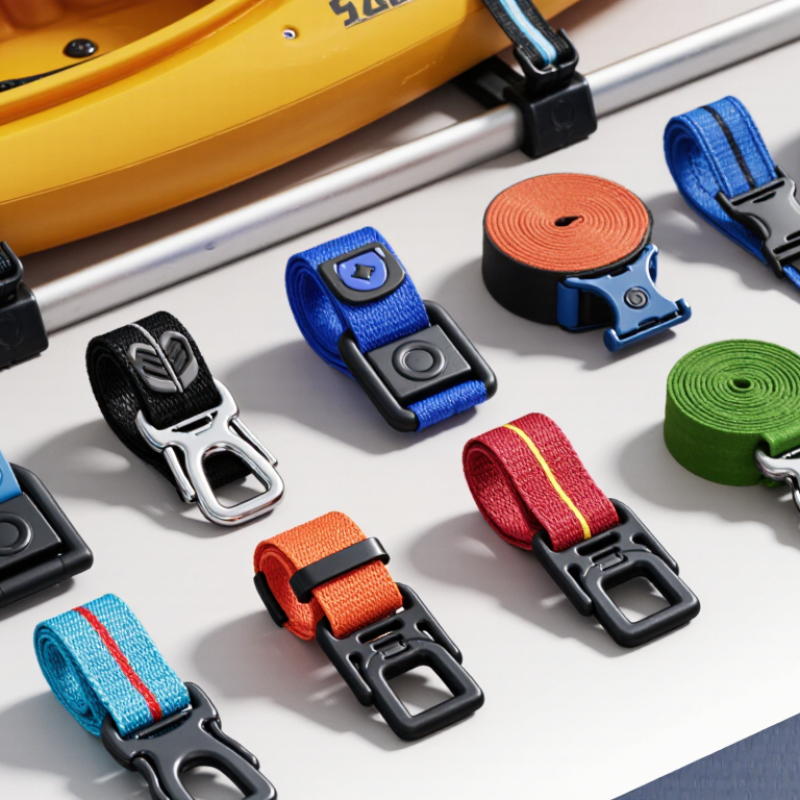
Cam straps are flat webbing straps with a compact buckle that grips the strap when pulled tight. The buckle lets a kayaker adjust tension without tools. Unlike a ratchet mechanism, it relies on hand pressure, making it easier to avoid crushing a kayak’s hull. Simple, but useful.
Kayakers use cam straps to secure a kayak to roof-rack crossbars during transport. The strap passes over the hull and around the bars, holding the boat in place when the vehicle turns or encounters bumps. A wide strap spreads pressure across more surface area than a narrow cord. Keep the buckle away from the hull when possible, and tuck loose strap ends so they do not flap in the wind.
Tight does not mean as hard as possible. Excess pressure can deform some hulls, especially in warm weather, so pull the strap snug and check that the kayak cannot slide. Inspect the webbing for fraying and the buckle for damage before each trip. Check them again after driving a short distance. Even careful setups can loosen as materials settle, and that small recheck is easy to forget.
Key Criteria for Evaluating Chinese Cam Strap Suppliers
When comparing Chinese cam strap suppliers, check the webbing, stitching, buckle, and test records—not just the quoted price. The Outdoor Industry Association’s 2024 Outdoor Participation Trends Report says 175.8 million Americans took part in outdoor recreation in 2023. That broad participation figure is not kayak-specific, but it underscores why dependable gear matters. Ask suppliers to distinguish working load from breaking strength and provide test results for the exact strap construction. ASTM D6775 provides a recognized method for testing textile webbing strength and elongation. Small details matter. Inspect bartack stitching, edge finish, buckle movement, and corrosion resistance, especially for saltwater use.
Tips: Request samples from the production line, not only showroom pieces. Compare measurements and test documents across batches. Confirm material composition, traceability, packaging, and lead times in writing.
A clean sample is useful, but it cannot prove long-term UV or salt exposure performance. That is an easy gap to miss. Ask how tests were conducted, what failed, and whether results cover the strap, buckle, and stitching together. A supplier’s answers can reveal more than a polished specification sheet. Even careful checks have limits; repeat testing after design or material changes.
China’s cam-strap supply base is best assessed through capabilities, not an unsupported ranking. The Outdoor Industry Association’s 2024 Outdoor Participation Trends Report counted 175.8 million U.S. outdoor participants in 2023. That figure signals broad outdoor interest, not kayak-strap sales. The distinction matters. Small details matter.
Ten useful supplier profiles include webbing mills focused on consistent weave; cut-and-sew workshops offering custom lengths; marine-hardware makers with corrosion-resistant fittings; buckle specialists able to document material grades; and low-minimum-order producers serving small launches. Other profiles include high-volume factories, OEM-integrated manufacturers, testing-focused vendors, export-packaging specialists, and suppliers combining webbing, hardware, and assembly. Each suits a different purchasing need. A low price alone proves little.
For kayak use, request strap-width and breaking-strength specifications, stitching details, and hardware material documentation. Ask how samples are tested after wetting and repeated tightening. A practical check is whether the buckle holds tension without slipping on damp webbing. Supplier claims should be verified against samples and written records; inspection methods can vary, and that is easy to overlook. Compare lead times, minimum orders, and replacement-part availability before committing.
When reviewing China’s top 10 best cam-strap suppliers for kayaks, compare more than catalog photos. Suppliers may offer 25 mm or 38 mm webbing, different buckle materials, and custom lengths. Ask how straps perform when wet, sandy, and repeatedly tightened. Request a sample with the exact buckle and stitching planned for production. It can reveal rough edges, slipping, or loose threads. Product descriptions alone are not enough.
Quality checks should be specific. Compare webbing width, stitch pattern, buckle grip, and stated load rating. Ask how performance figures were tested. A polished sample may not represent every production batch, so request inspection details and agree on acceptable defects. I have seen comparisons miss simple things, like releasing a buckle with cold, wet hands. Small details matter.
Tips: Send each supplier the same specification sheet, including strap length, width, color, buckle type, packaging, and customization needs. Ask about minimum order quantities, sample costs, lead times, and limits on custom colors or printing. Request a pre-production sample before approving a bulk order. Keep answers in writing. Fabric colors can vary slightly between batches, and that is worth discussing early. No comparison is perfect; daily use may expose stitching weaknesses that a quick sample check misses.
A supplier’s catalog is only a starting point. Ask for webbing material specifications, buckle composition, rated working load, and batch-level inspection records. Then compare those details with physical samples. Check for uneven stitching, sharp buckle edges, and straps that slip when wet. Small flaws matter.
The Outdoor Industry Association’s 2024 Outdoor Participation Trends Report says 175.8 million Americans took part in outdoor recreation in 2023, or 57.3% of the population. That figure signals broad outdoor participation, not kayak-strap demand specifically. Still, it gives buyers a reason to examine supply capacity and quality controls carefully. Ask how suppliers manage seasonal volume, replacement parts, and traceability when a production lot changes.
Request test reports for tensile strength and resistance to abrasion, moisture, and ultraviolet exposure. Where relevant, ask whether methods such as ASTM D6775 were used to measure webbing breaking strength. Verify that report details match the sample and production specification. A certificate alone is not enough. I would also test straps on a loaded roof rack, then recheck tension after a short drive. That practical check is imperfect, but paperwork can be imperfect too. Supplier selection should combine documented tests, consistent samples, clear communication, and realistic delivery records.