

How to Choose the Right Golf Clubs in 2026?
Choosing the right golf clubs in 2026 starts with your swing, not the newest model on the rack. The National Golf Foundation reported 26.6 million U.S. on-course golfers in 2023, a reminder that players bring a wide range of abilities and needs to the game. That figure describes participation, not equipment preferences. Still, it helps explain why one “best” set cannot suit everyone.
Club designer and fitting expert Tom Wishon has emphasized: “There is no such thing as a standard golf swing.” That idea matters when comparing shaft flex, club length, loft, and head design. A golfer who struggles to launch a seven-iron may need different specifications from someone who hits it high but misses left. A fitting session can reveal those differences through measured ball speed, launch, spin, and dispersion. Numbers help. So does noticing where your shots land.
This guide will explain how to match a golf club to your skill level, budget, and typical course conditions. It will also cover when to test clubs, what questions to ask a fitter, and which marketing claims deserve scrutiny. A costly fitting is not magic, and a perfect spreadsheet cannot replace practice. That is worth remembering. The goal is not to buy the most impressive bag; it is to choose clubs that produce more predictable shots and feel manageable in your hands.
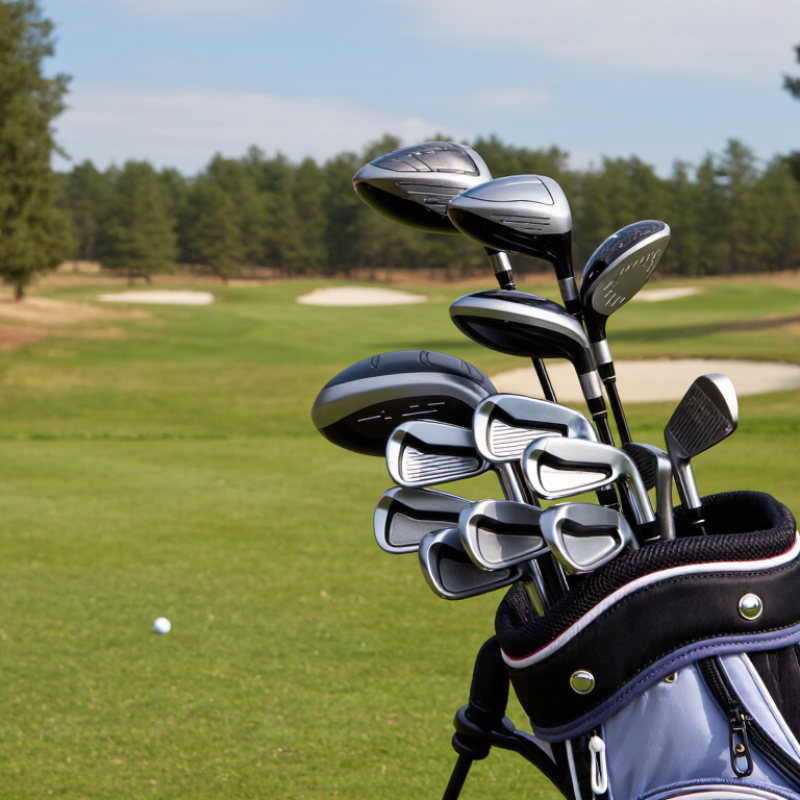
Understanding Golf Club Types and Their Roles
A driver is built for distance from the tee, with a long shaft and a large head that can send the ball far. It is not automatically the best choice on every hole. When trees narrow the landing area, a fairway wood or hybrid may offer more control. Fairway woods can also help from short grass, while hybrids blend features of woods and irons. They are often easier to launch than long irons.
Irons cover many approach shots. Lower-numbered irons generally travel farther, while higher-numbered irons help produce a steeper landing. The exact distance depends on the golfer, the club design, and the strike. That matters. Wedges are specialized irons for short shots, chips, and sand play. Their loft and sole shape affect how they move through turf or sand, so test them on the surfaces you actually play. A tidy chart helps, but real lies can be awkward.
The putter is used on the green, where pace and direction matter more than raw distance. A small change in grip or stroke can alter the roll, so practice on different green speeds. Club roles overlap; a hybrid might replace a long iron, but not for every player. Compare a few options with a qualified club fitter, and note carry distance, comfort, and miss patterns. The first club that feels right may not stay right.
How to Choose the Right Golf Clubs in 2026? — Understanding Golf Club Types and Their Roles
| Club Type | Typical Loft | Main Role | Design and Playing Characteristics | What to Consider When Choosing |
|---|---|---|---|---|
| Driver | About 8°–12° | Long tee shots, usually on holes where distance and a suitable landing area matter. | Has the largest clubhead and longest shaft in most sets. Its low loft is designed for long shots, but it can be harder to control than shorter clubs. | Choose a loft and shaft that help you launch the ball consistently. Prioritize a comfortable setup and a useful balance of distance and accuracy. |
| Fairway Wood | About 13°–21° for common models | Long shots from the tee or fairway; some players also use higher-lofted fairway woods for easier launch. | Usually has a smaller head than a driver and is designed to be playable from the ground as well as from a tee. | Consider how often you need a long club from the fairway. A higher-lofted option may be easier to launch than a lower-lofted one. |
| Hybrid | About 17°–30° | Long approach shots and replacement of hard-to-hit long irons. | Combines features of woods and irons. Its head shape and center of gravity can help many golfers launch the ball more easily than with a comparable long iron. | Compare its loft and carry distance with the clubs already in your bag to avoid overlapping distances. |
| Long and Mid Irons | Varies considerably by model; commonly about 18°–30° across longer and mid irons | Approach shots from longer or medium distances, depending on the iron and the player. | Irons have a flat-faced head and are commonly numbered. Lower-numbered irons generally have less loft than higher-numbered irons in the same set. | Choose irons that produce reliable contact and suitable distance gaps. If long irons are difficult to launch, compare them with hybrids. |
| Short and Scoring Irons | Often about 30°–45°, depending on the set | Approach shots from shorter distances and shots where control is important. | Higher loft than longer irons generally produces a higher launch and a steeper landing angle, although results depend on the golfer and the club design. | Check the lofts in your set rather than relying only on the number printed on each club; specifications vary between models. |
| Pitching Wedge | Often about 42°–48° | Short approach shots, pitch shots, and some full-swing shots. | Typically the lowest-lofted wedge and often included with an iron set. | Compare its actual loft with your next wedge to identify a practical distance gap. |
| Gap Wedge | Often about 48°–54° | Fills a distance gap between a pitching wedge and a sand wedge; useful for controlled shorter shots. | Also commonly called an approach wedge or utility wedge, depending on the set or manufacturer. | Choose one if there is a noticeable distance gap between your pitching wedge and sand wedge. |
| Sand Wedge | Often about 54°–58° | Bunker shots and shorter shots around the green. | Many sand wedges have a wider sole and bounce designed to help the club move through sand or turf. | Consider the bunkers and turf conditions you usually play. Sole width and bounce can affect how the club interacts with the ground. |
| Lob Wedge | Often about 58°–64° | High, short shots when a steep flight or quick stop is needed, including some shots over an obstacle. | Its high loft can be useful around the green, but it generally requires confident contact and suitable technique. | Choose one only if it fills a real need in your short game; compare its loft with your other wedges. |
| Putter | Usually about 2°–4° of face loft | Rolling the ball on the green toward the hole. | Designed for controlled putting strokes. Head shapes and alignment features vary, but feel and setup are personal. | Test aim, length, grip, and feel. Choose a putter that helps you start the ball on your intended line comfortably. |
Note: Loft ranges are typical examples, not universal specifications. Actual lofts, club numbering, and performance vary by set and design. When building a bag, compare the carry distances you achieve with each club and keep the total number of clubs within the 14-club limit for a round under the Rules of Golf.
Related Posts
-
What Are Custom Golf Clubs?
-
Why Choose Custom Golf Clubs for Your Business?
-
Top Golf Irons to Buy in 2025 for All Skill Levels
-

What Are Golf Irons? A Comprehensive Guide for Every Golfer
-
Top 10 Golf Drivers for Sale That Boost Your Game Performance?
-

2026 How to Choose the Best Golf Set for Your Game?